"It's got the visual equivalent of a defensive crouch."
That was one Landmarks Preservation Commissioner's verdict on a proposed new townhouse for a garden lot on Grace Court in February 2024. The design was cautious almost to a fault, opaque on the ground floor, set back from the street, clearly trying not to offend anyone. The commission rejected it anyway, according to Brownstoner's coverage of the hearing, because playing it safe wasn't the same thing as getting it right.
If you're weighing a purchase in Brooklyn Heights and you've started reading up on landmark rules, that's probably the kind of story you've absorbed: bold plans, packed hearings, months of back and forth, an uncertain outcome. It's a true story. It's also the exception. The commission that spent an evening picking apart a single-family house on Grace Court is the same commission that clears the overwhelming majority of its Brooklyn Heights applications at the staff level, often in weeks, without a hearing at all. The gap between those two experiences isn't about the neighborhood. It's about what, specifically, your project asks the commission to accept.
The Cases Nobody Writes About
Landmarks review runs on three tracks, not one. A Certificate of No Effect covers work that needs a Department of Buildings permit but doesn't touch anything the commission considers a protected feature. A Permit for Minor Work covers small exterior changes, like an in-kind window swap, that don't need a DOB permit at all. A Certificate of Appropriateness is the track that shows up in the news: it's required for additions, demolitions, and anything that visibly changes a building's character, and it can trigger a public hearing that adds months to a project.
The detail that rarely makes it into renovation guides is how lopsided that split actually is. Citywide, roughly 95 percent of Landmarks approvals are issued by staff rather than the full commission, according to Vandeck Builders' review of the agency's permitting patterns. The commission has also built faster lanes into the system for straightforward cases: a FasTrack option can clear both interior and exterior alterations in as little as 10 business days when the exterior work sits on a non-visible facade, and even Certificates of No Effect, while sometimes backlogged, typically move in about 60 days. The full hearing, with its 90-day minimum and the possibility of getting sent back for revisions, is reserved for a narrower slice of projects than most buyers assume.
What Actually Triggers a Full Review
The commission isn't grading your taste. It's asking a narrower question: does this change something visible from the street, and does that change read as restoration or as a departure. Work that routinely pulls a Brooklyn Heights property into deeper review includes:
Window or door replacement, especially anything that isn't a like-for-like match
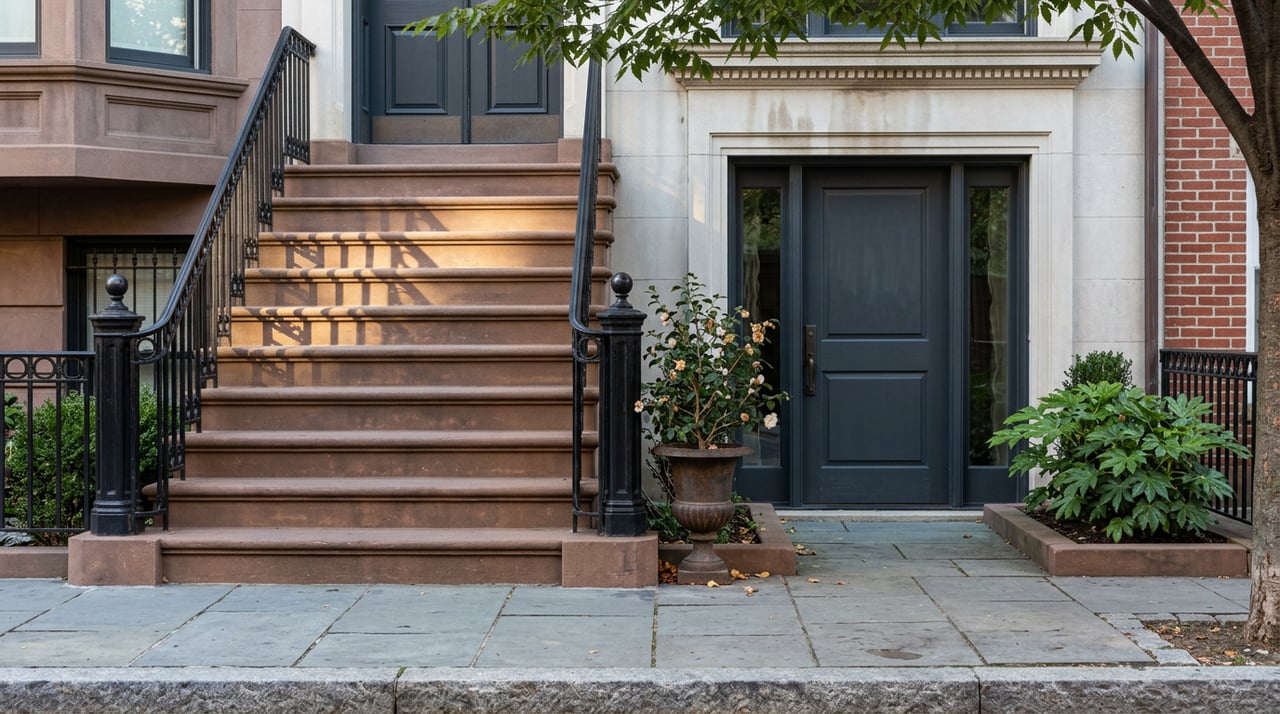
Stoop, railing, cornice, or masonry work beyond routine maintenance
Rooftop additions, bulkheads, or mechanical equipment visible from the street
Rear yard extensions and additions visible from a public way
Painting previously unpainted masonry or changing the color of a primary facade
Routine repairs, like replacing broken glass or repainting to match the existing color, don't need a Landmarks permit at all, per the commission's own guidance. The line between "maintenance" and "alteration" is where a lot of owners get caught off guard, particularly when interior work happens to require a DOB filing that touches the building envelope.
Three Cases Moving Through Brooklyn Heights Right Now
The commission's public hearing calendar for 2026 gives a useful snapshot of how differently these applications can be scoped, even within the same historic district.
Address | What's proposed | Filed | What it signals |
|---|---|---|---|
29 Willow Street | Remove a fire escape from an 1887 apartment house | Reviewed February 2026 | A narrow, single-element change, the kind of application that typically moves quickly |
183 Columbia Heights | Establish a Master Plan governing future window installations at a c. 1920 Beaux-Arts apartment house | Reviewed March 2026 | A proactive filing that pre-clears an entire category of future work instead of filing window by window |
89-91 Atlantic Avenue | Add a rooftop penthouse and change use from commercial to single-family residential at a loft building built circa 1900 | Reported May 2026 | A bigger ask, combining a change of use with new visible construction |
That middle case is worth sitting with. Rather than filing a fresh application every time a window needs replacing, the owner of 183 Columbia Heights asked the commission to approve a standard for all future window work on the building in one pass, according to the LPC's March 17, 2026 hearing calendar. It's a strategy that trades a bigger conversation now for years of avoided friction later, and it's the kind of move an owner only makes if someone on their team has been through this process before.
The 89-91 Atlantic Avenue filing, reported by New York YIMBY in May 2026, sits at the other end of the spectrum. A rooftop penthouse plus a change of use is the combination most likely to draw commission scrutiny, since it asks for both a new visible mass and a fundamentally different use than the building's history suggests.
Why the Same Commission Approves a Five-Story Insertion and Rejects a Modest New House
This is where the pattern gets genuinely useful for a buyer, because it cuts against the intuition that bigger projects always face harder odds. In June 2025, the commission reviewed a proposal to demolish most of a one-story former trolley powerhouse on State Street, preserving only its Art Deco street-facing facade, and build a five-story, five-unit condo building behind it. Commissioners raised concerns about the design's details, but they did not object to the basic premise of turning a one-story landmarked structure into five stories, even though, as Brownstoner noted, townhouse owners are routinely told their own additions can't be visible from the street at all.
The commission has also approved a rooftop addition at the St. George Tower on Hicks Street that included a new elevator bulkhead disguised as a water tower, an expanded roof deck, and a pool, as reported by 6sqft in 2023. One commissioner called the design "very well thought out."
Compare that to Grace Court, where a genuinely modest single-family house was turned down for being too deferential to its surroundings. The common thread isn't scale. It's whether the design reads as a coherent argument about how the building or block should look, versus a compromise that satisfies no one. A confident adaptive reuse with a preserved facade can clear the same commission that rejects a timid new build. That's not an accident of personnel. It's how a design-review body is supposed to work, and it means the strength of your architect's presentation matters as much as the square footage you're proposing.
What This Means If You're Buying
If you're under contract or close to it on a landmarked property in Brooklyn Heights, a few things follow directly from all of this:
Pull the building's landmark designation report before you finalize any renovation plans, and check its status on the Landmarks Preservation Commission's own Discover NYC Landmarks map so you know whether you're dealing with a historic district property, an individual landmark, or something with an interior designation, which is rare for residential rowhouses but changes the calculus entirely.
Budget time in proportion to visibility, not size. In-kind window repairs, masonry repointing, and similar restorative work can often move through a Certificate of No Effect or Permit for Minor Work in a matter of weeks. Anything that changes massing, adds a new use, or introduces a genuinely new form, like a rooftop addition or a rear extension, should be budgeted against a full Certificate of Appropriateness hearing cycle of three months or more.
Ask any architect or contractor bidding on the work how many Certificate of Appropriateness applications they've actually taken through a hearing, not just filed. The commission's questions get more specific as a design gets more ambitious, and a team without hearing experience will burn weeks relearning what a Grace Court or a State Street team already knows.
If you want a second opinion on a specific listing before you write an offer contingent on future renovation, the Brooklyn Heights Association's landmarks resources page keeps a running list of the commission's own guidance for homeowners, and it's a useful first stop before you talk to a design team.
FAQs
Does every property in Brooklyn Heights need Landmarks approval for renovation work?
Only exterior work visible from a public way generally requires review. The historic district, designated in 1965, covers most of the neighborhood, but the specific scope of what's regulated depends on the individual building's designation and what you're proposing to change.
What if I only want to renovate the interior?
Interior work in a residential brownstone typically doesn't need Landmarks approval unless the interior itself carries a separate landmark designation, which is uncommon for private homes. Interior work can still draw the commission into a supporting role if it requires a Department of Buildings permit tied to structural or envelope changes.
Is there a way to know before I buy whether a property's exterior plans will be an easy approval or a hard one?
Not with certainty, since the commission evaluates design quality and context case by case rather than against a fixed checklist. What you can do is have an architect experienced with Brooklyn Heights filings review your specific plans against the building's designation report before you're locked into a timeline.
Buying a landmarked brownstone in Brooklyn Heights isn't a reason to slow down. It's a reason to ask sharper questions before you write an offer, especially if your plans depend on changing anything the street can see. If you're evaluating a property here and want to talk through what its designation actually means for your plans, The Peter Mancini Team can help you get a clear picture before you're under contract. Get Your Home Valuation and let's talk through what you're working with.