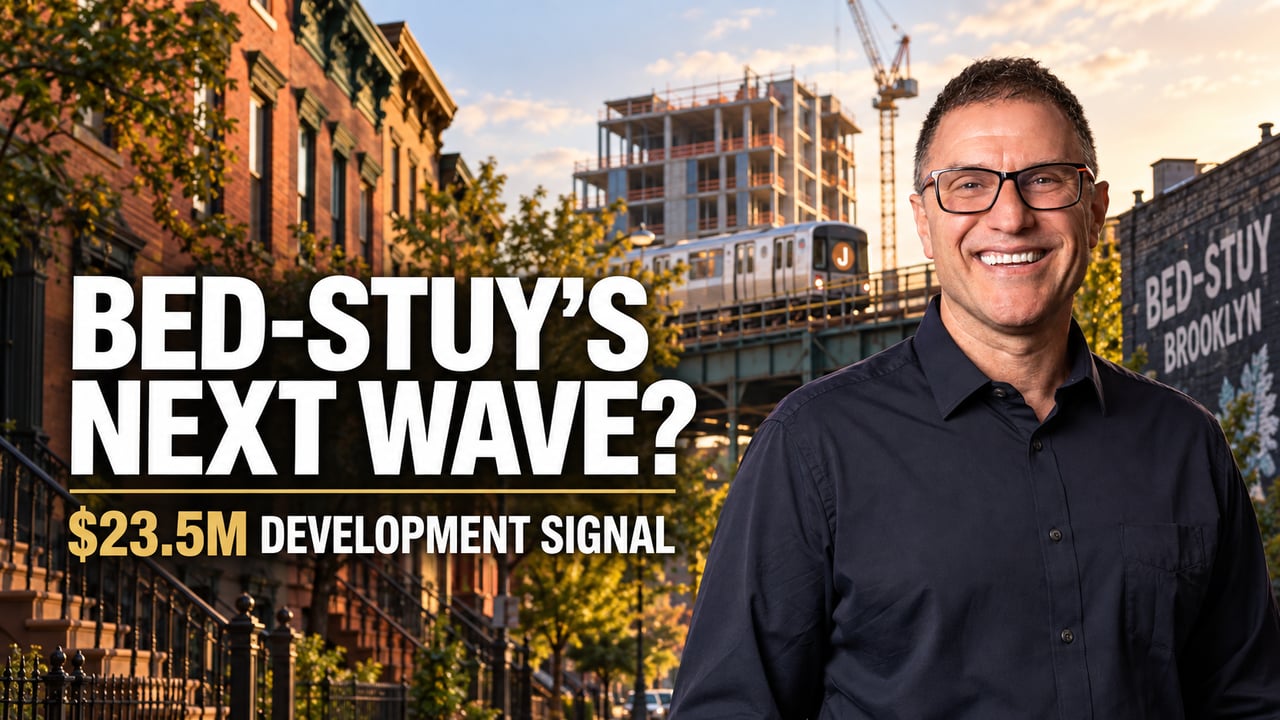
Is Bed-Stuy Entering Its Next Development Wave? What the $23.5 Million Sale of 1150 Broadway Could Signal
In music, sometimes one note tells you where the entire piece is heading.
The $23.5 million sale of 1150 Broadway in Bedford-Stuyvesant may be one of those notes for Brooklyn real estate. By itself, the transaction is a significant land deal. Placed beside newly filed building plans, a neighboring development proposal, transit access, updated zoning potential, and tax incentives, it becomes something more: a signal worth interpreting.
For buyers, sellers, investors, and longtime residents, the important question is not simply, “What is being built?” The better question is, “What could this concentration of investment mean for the neighborhood over time?”
That distinction matters because real estate decisions should not be driven by hype. They should be guided by verified information, local context, and a clear understanding of what is known today—and what remains uncertain.
What Happened at 1150 Broadway?
According to JLL’s announcement of the transaction, Brooklyn-based YS Developers and Rabsky Group acquired 1150 Broadway for $23.5 million. JLL represented the seller, A-PLUS International Realty, and negotiated directly with the buyers.
The 26,730-square-foot corner property sits between Kosciuszko Street and Lafayette Avenue, at the meeting point of Bedford-Stuyvesant and Bushwick. It currently contains six storefronts and a parking lot, with substantial frontage along Broadway and several surrounding streets.
Location is central to the story. The site is directly in front of the Kosciuszko Street J train station, providing access to Lower Manhattan and connections throughout Brooklyn and Queens. In a city where transportation often shapes housing demand, retail activity, and development feasibility, that proximity is not a minor detail. It is part of the property’s underlying value.
The Plans Already on File
The sale did not arrive without a development framework. In April 2026, New York YIMBY reported that permits had been filed for an 11-story mixed-use building at 1150 Broadway.
Those filings describe a 115-foot-tall structure spanning 71,137 square feet. The proposal includes 67,825 square feet of residential space, 3,312 square feet of commercial space, 99 residences, a cellar, a side yard, and 24 enclosed parking spaces. YIMBY noted that the apartments would most likely be rentals based on an average unit scope of approximately 685 square feet.
Next door, a companion filing at 1164 Broadway calls for another 11-story building containing 98 residences. Together, the two proposals could create 197 new homes near the J train.
That is the headline number, but it requires context. Filed plans are not the same as completed buildings. As of YIMBY’s reporting, demolition permits had not been filed and no estimated completion date had been announced. Designs, timelines, financing, and even unit counts can change before a project reaches the market.
Why the Zoning Potential Matters
The existing filings tell us what has been proposed. The zoning tells us what may be possible.
In its August report on the acquisition, YIMBY stated that the property carries up to 133,917 square feet of as-of-right zoning floor area under the City of Yes for Housing Opportunity program. That figure is significantly larger than the 71,137-square-foot building described in the original permit filing.
It does not mean the new owners will necessarily build to the maximum. It does mean the site offers flexibility. Developers can evaluate the existing applications against current zoning, construction costs, financing conditions, rental demand, and the economics of a larger project.
The property also lies within a federally designated Qualified Opportunity Zone and is eligible for the 485-x tax-abatement program. JLL reported that the program may provide a 35-year property-tax exemption while eliminating parking requirements. These incentives can materially affect whether a project is financially workable, especially when land, labor, materials, and borrowing costs remain substantial.
Zoning creates capacity. Transit creates access. Tax policy influences feasibility. Capital determines whether the opportunity becomes a building.
What Buyers Should Watch
For Brooklyn buyers, new development can expand choice, but the effects are rarely immediate or uniform.
Additional apartments may introduce newer finishes, elevators, amenities, and professionally managed rental inventory. New storefronts may also attract services that improve everyday convenience. At the same time, construction can create temporary disruption, and new buildings may enter the market at pricing that reflects the cost of development rather than the affordability expectations of current residents.
Buyers considering the surrounding area should evaluate more than a property’s interior. Look at nearby filings, zoning maps, vacant or underbuilt lots, transit infrastructure, and the neighborhood’s development pipeline. A beautiful apartment may still face years of construction next door. Conversely, buying near future investment can provide access to an area before its next chapter is fully recognized.
The goal is not to predict perfectly. It is to purchase with your eyes open.
What Sellers Should Understand
For homeowners and property owners, major development nearby does not automatically increase every property’s value. Market impact depends on property type, condition, timing, supply, buyer demand, and how the completed project changes the immediate environment.
A new building can bring attention, foot traffic, retail activity, and confidence. It can also introduce competing inventory, particularly for sellers of comparable condominium units or investment properties. That is why pricing should remain grounded in recent closed sales, current competition, and the specific strengths and limitations of the property being sold.
The most useful response is preparation. Understand what is proposed, monitor the project’s progress, and communicate the neighborhood story accurately. Buyers respond to clarity. Overstating an unbuilt project as a guaranteed benefit can weaken trust.
What Investors Can Learn
For investors, the 1150 Broadway sale illustrates the combination many developers seek: substantial frontage, as-of-right development potential, transit proximity, tax incentives, and demand for housing at the edge of two established Brooklyn neighborhoods.
It also demonstrates why headline numbers never tell the entire story. A $23.5 million acquisition is only the starting point. A serious analysis must consider buildable square footage, basis per buildable foot, demolition, construction, financing, labor requirements, operating assumptions, lease-up, taxes, and exit strategy.
The planned 99- and 98-unit buildings also show how policy thresholds can influence project design. Investors should study the rules closely, but they should also evaluate execution risk. The best-looking opportunity on paper still depends on disciplined underwriting and realistic assumptions.
What This Could Mean for the Street
Development is experienced at street level. Residents may notice construction activity, changing storefronts, increased foot traffic, and interest from renters or buyers who prioritize transportation. Local businesses may gain customers, although commercial rents and tenant turnover deserve equal attention. The character of a block is shaped not only by building height or unit count, but also by how the ground floor meets the sidewalk, which businesses occupy the space, and whether the project contributes to neighborhood life. Those outcomes cannot be known from permit filings alone. They should be watched as plans advance.
Listen for the Direction, Not Just the Noise
As a former New York City music teacher and trained tenor, I learned that one note has meaning because of its relationship to everything around it. Tempo, harmony, tension, and resolution tell you where the composition may be going.
Brooklyn real estate works in a similar way. One sale is not a market. One permit is not a completed project. But when a major acquisition, two residential proposals, transit access, expanded zoning capacity, and economic incentives appear together, they create a pattern worth hearing.
1150 Broadway may become an important development for Bedford-Stuyvesant, or the final result may differ from today’s plans. Either way, it is a reminder that neighborhoods evolve through a series of connected decisions long before the cranes arrive.
If you are buying, selling, or investing in Brooklyn, understanding those early signals can help you prepare rather than react. The right strategy begins with the facts, continues with local context, and ends with a decision aligned with your goals.
I’m Peter Mancini, providing Clarity You Can Act On. Results You Can Trust.
To discuss your Brooklyn real estate plans, visit PeterManciniNYC.com.